Sliding Puzzle: Order the Tiles
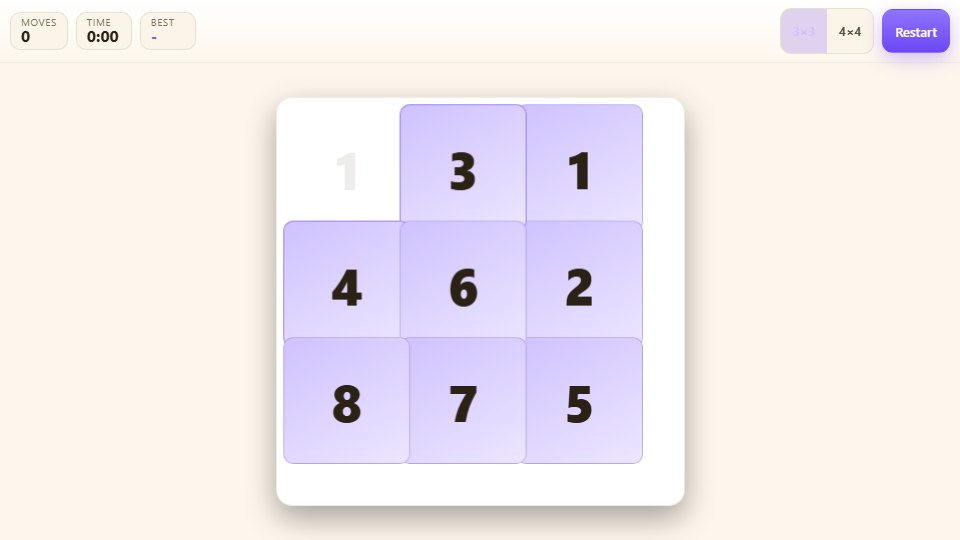
Slide numbered tiles into the empty space until every digit sits in order. Choose a quick 3x3 or a tougher 4x4 and chase your fewest-moves record.
Keyboard works too Everything runs inside your browser. Nothing is installed on your phone.
Controls
Tap 3x3 or 4x4 to choose your grid size and shuffle the board.
How to play
- Tap 3x3 or 4x4 to choose your grid size and shuffle the board.
- Tap a tile next to the empty space to slide it into the gap.
- Arrange the numbers 1 upward, leaving the blank square last.
- Watch your move counter and keep it as low as you can.
- Finish the order to see your time and your best move count.
About this game
Sliding Puzzle is the timeless tile slider, rebuilt so it feels natural under a fingertip. Numbered squares sit inside a frame with one empty space, and your task is to shuffle them until they read 1, 2, 3 and onward in order. It has been frustrating and delighting people for well over a century, and the appeal has not faded a single bit.
Because there is no time pressure, it becomes a pure logic exercise, the kind you can chew on while waiting for a bus that never seems to arrive. Every solve is a small, quiet victory that you can trace back to your own thinking rather than to luck or speed.
What you actually do
Choose a 3×3 grid for a quick solve or step up to 4×4 when you want a real test. Tap any tile sitting directly beside the empty space and it slides across into the gap. Tiles with a brighter border are the ones you can move right now, so you never have to guess which square will respond to your touch.
Every slide counts as one move, and a timer starts as soon as you make your first tap. Your best move count is remembered for the grid size you are playing, so a tidy small-board record stays separate from the bigger challenge. When the numbers finally land in order, the board glows green and the game marks a clean solve with a short, cheerful chime that feels well earned.
Tips that make you better
- Solve the top row first, then resist touching it again as you work your way downward.
- Think in loops: rotate a small block of tiles to cycle numbers into place instead of nudging one at a time.
- Plan two or three slides ahead before you tap, so you never accidentally undo your own hard-won progress.
- On the 4×4, handle the final two rows as a matched pair, since they are the trickiest part of any solve.
- Count moves rather than seconds, because fewer moves is the score that truly matters here, not how fast you tapped.
Who it is for
Anyone who enjoys quiet spatial puzzles will feel at home, and it makes a gentle starter for players who find fast arcade games stressful. It also rewards a patient, methodical mind far more than lightning reactions, which makes it a nice change of pace.
Playing it on a phone
Tap targets are generous and the board scales to the screen, so it plays comfortably one-handed on a mid-range phone. A soft click confirms each slide, the numbers stay crisp at any size, and the whole thing runs offline in your browser, so it is ready even in a tunnel between stations with no signal at all.
Frequently asked questions
Which grid should I start with?
Begin with 3x3, which has eight tiles and is quick to solve. Move up to the 4x4 with fifteen tiles once the smaller board feels comfortable.
Is it always solvable?
Yes. The board is shuffled by making legal slides from the solved position, so a solution always exists. You are never handed an impossible layout.
How is my best tracked?
Your fewest moves are stored per grid size on your own device, so a tidy 3x3 record is not lost when you attempt the harder 4x4.
Can I use the keyboard?
Yes. The arrow keys or W, A, S, D move a tile into the gap, and R restarts while P pauses the game.